About this project
This is a complete learning needs analysis report, ten pages in PDF, for a fictional software company's support team. It shows how I work out what is really going wrong before anything is built: the performance gap, the root causes, which causes training can fix, how the job's tasks compare, who the learners are, how their first thirty days feel, and what to do first.
A needs analysis is the step that stops a team building the wrong course. It separates problems that training can solve from problems caused by tools, processes or environment, and it points the budget at the biggest, most fixable gaps. The company, people and data in this report are illustrative, because this is an original portfolio piece and not client work.
Who this document is for
- Business leaders and sponsors who want evidence before they commission training.
- Learning and development teams who need a clear analysis to justify what they build.
- Managers who suspect that "more training" is not the answer and want proof either way.
- Anyone hiring an instructional designer who wants to see how I investigate a problem, not only how I build a solution.
What the report contains
| Page | Section | What it shows |
|---|---|---|
| 1 | Cover | Title and scope |
| 2 | Executive summary | The problem, three key findings, the recommendation and headline measures on one page |
| 3 | Method | Four evidence sources compared, the questions asked and a survey chart |
| 4 | Gap analysis | Desired versus current performance, and a root-cause table that marks which causes training can fix |
| 5 | Task analysis | A bubble chart of six core tasks by frequency, difficulty and impact, with training priorities |
| 6 | Learner personas | Three personas with original characters: goals, frustrations, context and how each learns best |
| 7 | Journey map | Confidence over the first thirty days, with the moments that need support |
| 8 | Priorities | An impact and effort matrix and a ranked list of needs |
| 9 | Recommendation | A blended solution, what is not a training problem, and how success will be measured |
| 10 | Plan | Six-week timeline, risks, next steps and a sign-off block |
The thinking behind it
Use more than one source of evidence
Interviews tell you what leaders believe. Surveys show how people feel. Ticket reviews show what happens, and observation shows how work is really done. The analysis compares all four so that one loud opinion does not decide the answer.
Separate training problems from everything else
Each root cause is classed as knowledge, skill, tools, process, motivation or environment, and marked as a training problem or not. In this example, agents lack a routine for tense conversations, which training can fix. But the knowledge base search is poor, which is a tool problem, and weekend agents lack coaching, which is a process problem. Training would not solve either.
Look at the job, not just the topic
The task analysis charts the job's tasks by how often they happen, how hard they are and how much mistakes matter. The task that is common, hard and important, handling upset customers, becomes the first priority.
Know the learner
Personas turn data into people. Maya is a new starter who freezes with angry customers. Dev is experienced and needs exact steps. Priya works weekends and has nobody to ask. Each persona points to a different format: practice scenarios, a job aid and mobile microlearning.
Map the experience
The journey map shows that confidence dips at predictable moments, such as the first angry customer on day fourteen. Support placed at those moments is more useful than support spread evenly.
Recommend the smallest solution that works
The recommendation matches each cause with the right response: a practice module, job aids, a decision guide, a coaching guide and a weekend support plan. It also tells the sponsor what training will not fix.
A closer look at three sections
The root-cause table
This is the heart of the report. Each cause is listed with its evidence, its type and a clear answer to "does training fix this?". For example, "no routine for tense conversations" is backed by the ticket review, observation and a low survey score, and it is a skill gap, so the answer is yes. "Knowledge base search returns irrelevant results" is backed by observation and survey comments, and it is a tool problem, so the answer is no: fix the tool. Reading this table, a sponsor can see at once why not everything becomes a course.
The task bubble chart
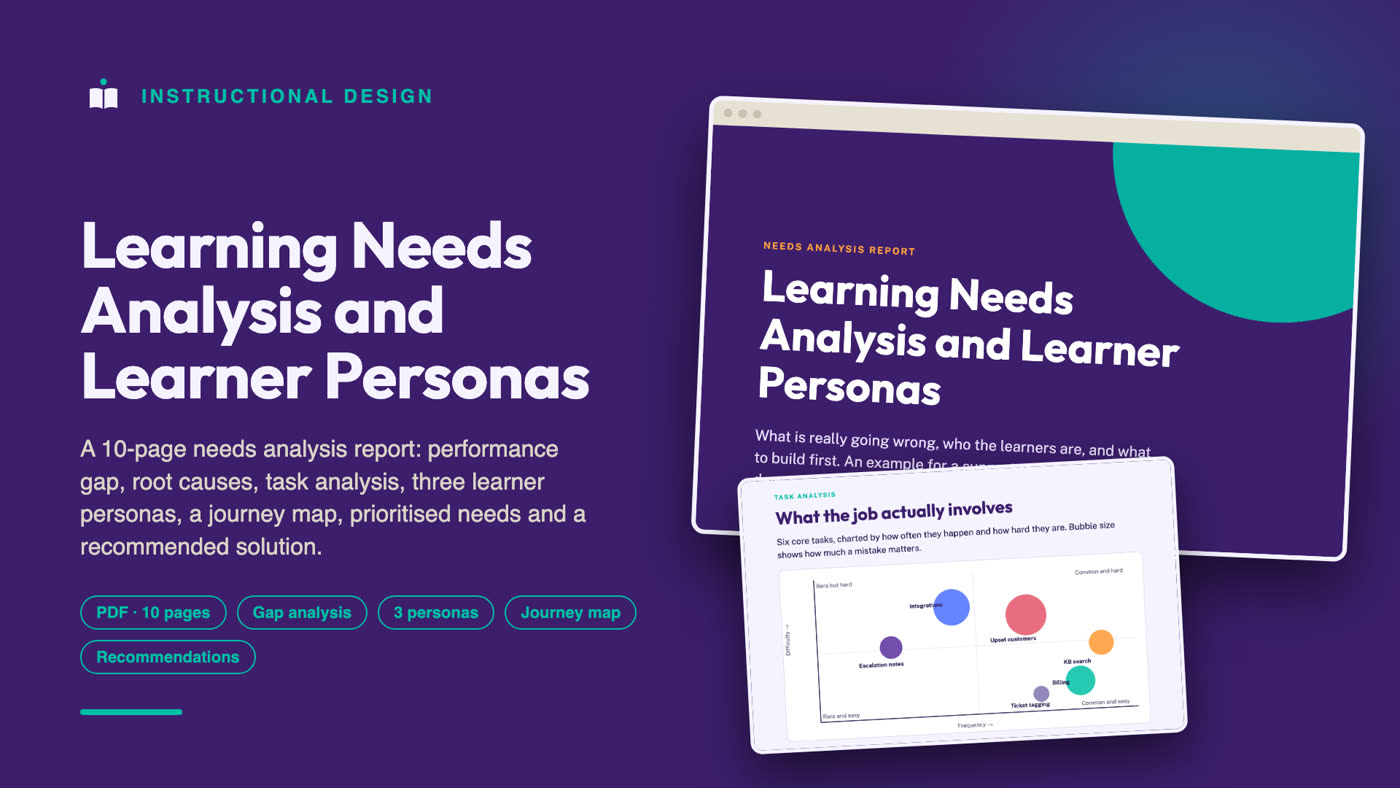
Six tasks are plotted by how often they happen and how hard they are, with bubble size showing how much a mistake matters. Billing questions are common but easy, so a quick refresher is enough. Integrations are rare but hard, so a job aid fits. Handling upset customers is common, hard and important, so it gets a practice-based module. The chart turns a long list of tasks into a clear order of attack.
The journey map
Confidence is drawn as a curve across four stages: orientation, shadowing, first tickets and independent work. It starts high, drops as the volume of information sinks in, dips again at the first angry customer and then climbs. The table underneath names the feeling, the need and the support for each moment. That is how the plan decides where a mentor check-in, a job aid or a practice scenario will help most.
How I would adapt this for your team
- Scope the question. We agree what performance problem you want to solve and what success would look like.
- Gather the evidence. I plan the interviews, survey, data review and observation, and I analyse what comes back.
- Report and recommend. You receive a report like this one, with findings, personas, priorities and a recommended solution.
- Decide together. In a short review we confirm priorities, and I can move straight on to a course outline and storyboard.
How the document is designed
The report uses a violet, mint and orange palette with a friendly geometric headline font, clear tables and hand-built charts: a survey bar chart, a task bubble chart, a journey curve and a priority matrix. Every page has one purpose so busy readers can scan it. Original 2D characters bring the personas to life.
What a project like this includes
- A kick-off conversation and a plan for gathering evidence
- Analysis of your interviews, survey results, tickets or observations
- A report like this one, tailored to your team and problem
- A review round and one consolidated revision
- A recommended solution and a plan, with a course outline if you want to continue
- A walkthrough video that explains the findings to your stakeholders
Skills shown in this document
Instructional design, needs analysis, performance gap analysis, root cause analysis, task analysis, learner personas, journey mapping, training evaluation, project planning, data visualisation and technical documentation.
Work with me
I am an instructional designer and LMS specialist. I investigate problems, plan solutions and build self-paced courses, and I set up learning platforms. Send me your topic, your learners and the problem you need to solve, and I will reply with where I would start.
Browse the pages
Frequently asked questions
What is a learning needs analysis?
A learning needs analysis is a structured investigation of a performance problem. It finds out what people should be able to do, what they do now, why there is a gap, and which part of the gap training can close.
How is a needs analysis different from a course outline?
The needs analysis comes first and decides whether training is the answer and what it should cover. The course outline then plans the course in detail.
How long does a needs analysis take?
For a team of this size, usually two to four weeks, depending on how quickly interviews, survey responses and data arrive.
What if training is not the answer?
Then the report says so. Recommending a tool fix or a process change is part of the value, because it saves money that would be wasted on a course that cannot help.
Are the figures and company in this report real?
No. This is an original example. The company, people and data are illustrative, and real targets would be agreed with a sponsor after a baseline review.
Can you also build the training afterwards?
Yes. I plan and build self-paced SCORM courses with scenarios, original characters and demo videos, and I set up and fix learning platforms.