About this project
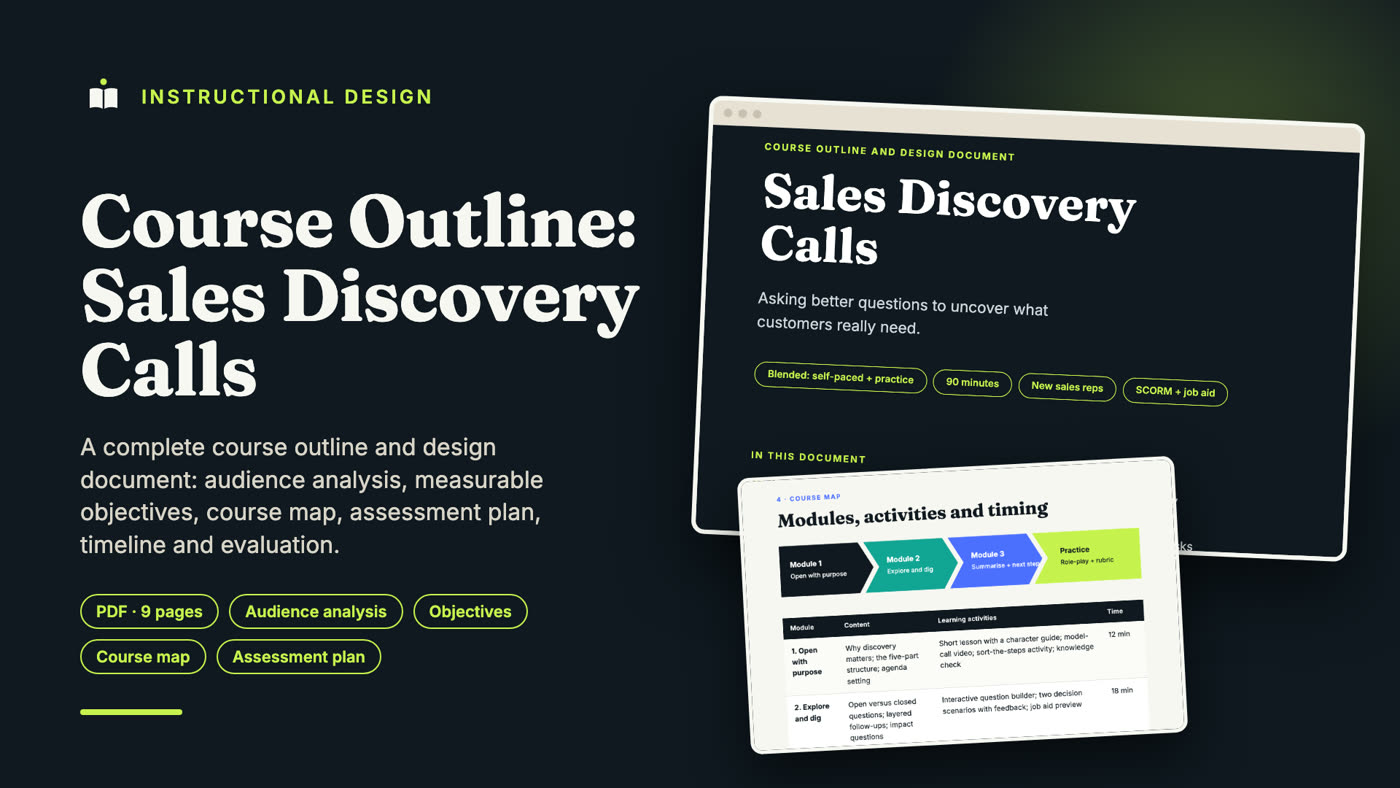
This is a complete course outline and instructional design document, nine pages in PDF, for a blended training programme called Sales Discovery Calls: Asking Better Questions. It shows how I move from a business problem to an approved plan: a project snapshot, audience analysis, measurable learning objectives, a course map, an instructional strategy, an assessment plan, a timeline with risks, and an evaluation plan.
An outline is the document that protects a project. It gets stakeholders to agree on who the learners are, what they must be able to do and how success will be measured, before any content is built. This example shows the level of detail and clarity I bring to that stage. The organisation, learners and figures are illustrative, because this is an original portfolio piece and not client work.
Who this document is for
- Managers and sponsors who must approve a training project and want to know exactly what they are approving.
- Learning and development teams who need a clear brief before they commission or build a course.
- Subject-matter experts who need to see how their knowledge will be turned into learning activities.
- Anyone hiring an instructional designer who wants to see how I plan, not only what I build.
What the document contains
| Section | What it covers |
|---|---|
| 1. Project snapshot | Format, duration, audience, delivery, pass requirement, the performance problem and proposed success measures |
| 2. Audience analysis | A learner persona, prior knowledge, motivation, barriers, context and a five-task analysis of a strong discovery call |
| 3. Learning objectives | Six measurable objectives at remember, understand, apply and analyse levels, each linked to how it will be assessed |
| 4. Course map | Four modules with content, learning activities and timing, plus a plan for media and interactions |
| 5. Instructional strategy | A model, practise, feedback and transfer approach, with design principles |
| 6. Assessment plan | Formative checks, a scored online assessment, a role-play rubric and on-the-job review |
| 7. Timeline, roles and risks | A six-week plan, who does what, and the main risks with mitigations |
| 8. Evaluation | Four levels from reaction to results, and next steps with a sign-off block |
The thinking behind it
Start with the performance problem
The outline begins with what is going wrong on the job, not with a topic. In this example, new reps spend discovery calls on features and price, ask closed questions and accept vague answers. That problem defines the objectives, and the objectives define everything else.
Objectives you can observe
Each objective names an observable behaviour, such as "ask at least four open, layered questions in a ten-minute call". If a behaviour cannot be observed, it cannot be taught or tested, so it is rewritten or removed. Every objective is matched to an assessment, and every activity supports an objective.
Design for the learner's real day
The audience analysis uses a persona and a task analysis so design choices are grounded in how the learner works: back-to-back calls, remote work and learning in short gaps. That is why the course uses short modules, one idea per screen and a job aid.
Blend the right methods
Self-paced modules are efficient for knowledge and decisions. Speaking skills need live practice, so the plan includes a facilitated role-play with a rubric. The document explains why each method was chosen.
Plan how you will know it worked
Completion is not impact. The assessment and evaluation sections cover scoring in the LMS, a performance rubric, manager call reviews and business measures, using a four-level model.
A closer look at three key sections
Learning objectives that can be tested
The objectives table pairs each behaviour with a level of thinking (remember, understand, apply, analyse) and the way it will be assessed. For example, "open a call with a clear purpose and agenda in under 60 seconds" is an apply-level objective checked by the role-play rubric, while "identify the missing information in a set of discovery notes" is an analyse-level objective checked by a notes review task. This makes the assessment plan almost write itself, and it lets a sponsor see exactly what each learner will be able to do.
The course map
The course map shows four modules on one flow diagram and then expands each in a table with content, activities and timing. Learners spend 45 minutes in self-paced modules and 45 minutes in a facilitated practice session. Media is planned from the outset: two short animated model-call videos, four decision scenarios and a one-page job aid, so nothing is added late and surprises the budget.
The role-play rubric
The assessment section includes a four-criterion rubric (opening, questioning, listening and next step) with three performance levels. A shared rubric makes feedback fair and specific, and it doubles as a checklist learners can use on real calls. Managers use the same rubric to review recorded calls in week four, so training and coaching speak the same language.
How I would adapt this for your project
- Discovery. A short conversation and questionnaire to understand the problem, the learners and the constraints.
- Draft outline. A first version of this document, filled with your real audience, objectives and measures.
- Review. One consolidated review round with your stakeholders, with changes tracked and explained.
- Sign-off. A confirmed outline that becomes the basis for the storyboard, the build and the evaluation.
How the document is designed
The document is designed to be read by busy people. Each page has one purpose, a clear heading, scannable tables, a simple course-map diagram and a timeline chart. It uses a bold ink and lime colour palette, a serif headline font and original 2D characters for the learner persona and the cover scene.
What a project like this includes
- A kick-off conversation and a short discovery questionnaire
- A course outline and design document like this one, tailored to your topic
- A review round with your stakeholders and one revision
- A storyboard and build plan if you want me to continue to development
- A walkthrough video that explains the document to your team
Skills shown in this document
Instructional design, needs analysis, audience analysis, task analysis, learning objectives, course design, curriculum planning, assessment design, rubric design, project planning, training evaluation, sales enablement training and technical documentation.
Work with me
I am an instructional designer and LMS specialist. I plan, design and build self-paced courses and set up learning platforms. Send me your topic, your learners and the problem you need to solve, and I will reply with where I would start.
Browse the pages
Frequently asked questions
What is a course outline in instructional design?
A course outline is a planning document that defines the audience, objectives, modules, activities, assessments and timeline for a training course. Stakeholders approve it before development starts.
How is an outline different from a storyboard?
The outline sets the plan for the whole course. The storyboard comes next and describes each screen or session in detail, including text, media, interactions and feedback.
How long does an outline take to produce?
For a course of this size, usually one to two weeks including discovery and one review round, depending on how quickly stakeholders respond.
Can you adapt this to my topic and industry?
Yes. The structure stays the same, while the content, examples, objectives and measures are tailored to your learners and goals.
Are the figures and company in this document real?
No. This is an original example. The organisation, roles and measures are illustrative, and any targets would be agreed with a real sponsor after a baseline review.
Do you also build the course afterwards?
Yes. I build self-paced SCORM courses with interactions, scenarios and characters, and I set up and fix learning platforms.