About this project
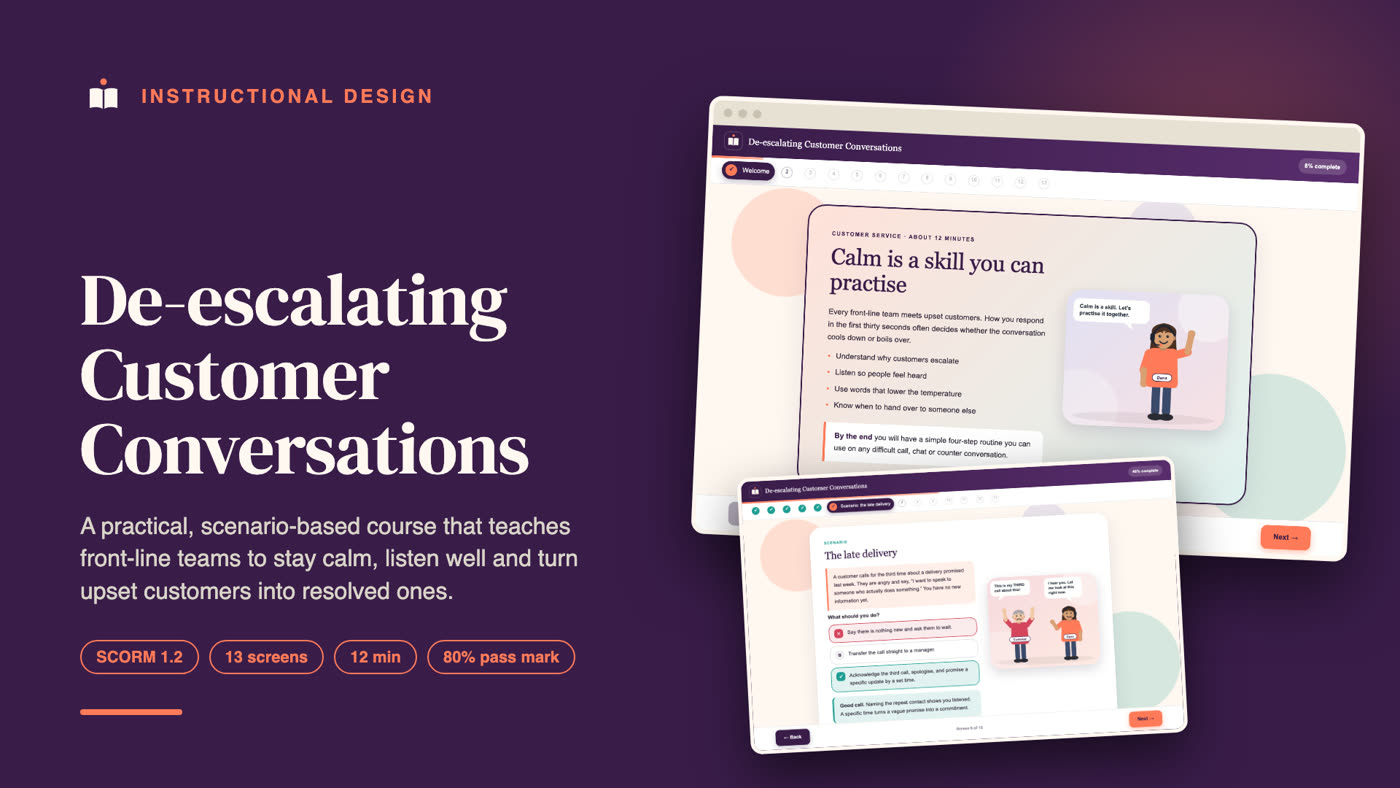
De-escalating Customer Conversations is a 12-minute, scenario-based eLearning course that teaches front-line teams how to stay calm, listen well, choose words that lower the temperature, and know when to hand a conversation over. It is built as a SCORM 1.2 package for any compatible learning management system (LMS) and also runs in a browser as a web version.
I designed, wrote and built the whole course, from the learning objectives and storyboard to the interactive screens, scenarios, scored assessment and SCORM packaging. This page describes what is inside and why it is designed this way.
Who this course is for
- Customer service, support, retail and hospitality teams who deal with upset customers every day.
- Team leaders who want a consistent way to coach de-escalation without running a full workshop.
- Training managers and HR teams looking for a short, practical soft-skills module for an LMS.
- Course creators and training providers who sell customer service content to clients.
The problem it solves
Most training on difficult customers is either a list of tips or a long policy document. Neither helps at the moment a customer is shouting, typing in capital letters, or threatening a bad review. In that moment people freeze, defend themselves, or say something that makes it worse, such as "calm down" or "that is our policy".
This course practises the moment itself. Learners work through realistic situations, make a choice, and see exactly why that choice helps or hurts. The goal is a routine they can use automatically, not a list they can recite.
Learning objectives
By the end of the course, learners can:
- Name four common reasons customers escalate and recognise them in a real conversation.
- Use a four-step routine (listen, label, clarify, act) to respond to an upset customer.
- Replace phrases that inflame with phrases that help, including how to say no kindly.
- Decide when a situation needs a manager, a colleague or a safety procedure, and hand it over well.
Every screen, scenario and assessment question supports one of these four objectives.
Course structure
The course has five modules and twelve screens:
| Module | What the learner does |
|---|---|
| 1. Stay steady | Reads the outcomes, explores four reasons conversations heat up, chooses a first reply to an angry chat |
| 2. Listen first | Learns the four-step routine, handles the "late delivery" scenario, picks the best empathy statement |
| 3. Choose your words | Swaps inflammatory phrases for helpful ones, handles "the refund you cannot give", practises saying no kindly |
| 4. Know your limits | Learns when to escalate and how to make a warm hand-over |
| 5. Assessment | Takes an 8-question final assessment and receives a completion certificate |
A walk through the course
A learner opens the course and sees four clear outcomes. On the next screen they open four colour-coded cards explaining why customers escalate: not feeling heard, waiting too long, unclear answers and repeated mistakes. A short check then drops them into a chat that opens with "YOUR BILLING IS WRONG AGAIN!!!" and asks for the best first reply. The tempting wrong answers, "please calm down" and quoting policy, are explained, not just marked wrong.
In module two they learn the routine and apply it in a scenario where a customer has called three times about a late delivery and there is no new information. The best answer names the repeat call, apologises and promises a specific update time. A short check then separates real empathy from a generic "I understand".
Module three covers wording. Learners see inflammatory phrases next to helpful ones and then face a customer who wants a refund the policy does not allow. They choose how to say no while still offering something, and see why that keeps the customer's sense of control. The final module explains when to hand over, such as threats, safety concerns or limits of authority, and how to do it without making the customer repeat everything.
Design choices that make it work
Practise the moment, not the policy
Each scenario puts the learner in the seat of the agent, with a short, vivid setup and three realistic choices. One option is plausible but poor, one is the strongest, and one is a common instinct that backfires.
One routine to remember
Listen, label, clarify, act. A short routine is easier to recall under pressure than a long checklist, and every scenario returns to it.
Feedback that coaches
Every answer has its own explanation. A learner who chooses the wrong option learns why it fails and what to try instead, and the Next button stays locked until they pick the best answer.
Words to copy
The wording screen shows exact phrases to use. Concrete language is easier to copy than advice to "be empathetic".
Respect for limits
The course is clear that de-escalation does not mean tolerating abuse. It teaches learners to warn once, end the conversation and report it, so staff feel protected.
Characters and demonstration video
The course features original 2D characters, drawn for this project with different skin tones, hair and outfits, so learners see people like themselves in the scenarios. A friendly guide welcomes learners on the first screen, and each scenario shows the people involved with speech bubbles.
A short animated demonstration video, "calming an upset customer in four steps", plays inside the course. It shows the skill being done step by step, with captions and step labels, before learners practise it. The video is packaged inside the SCORM file and has a transcript for accessibility.
SCORM and LMS details
The course is a SCORM 1.2 package with a valid manifest and a single launchable SCO.
- Status: reports incomplete, passed or failed to the LMS.
- Score: reports a raw score from 0 to 100, with the 80% mastery score declared in the manifest.
- Resume: saves the learner's position and progress.
- Browser version: with no LMS present, the same course runs in a browser and saves progress locally.
Visual design and accessibility
This course has its own look: a warm plum and coral palette, rounded shapes, a step-by-step menu along the top and original vector illustrations. Right and wrong answers use a tick or cross as well as colour, text is large with strong contrast, every control is a real button that works with a keyboard, and the layout adapts to smaller screens.
How it was built
I wrote the content first and then built it with a reusable course player in HTML, CSS and JavaScript that reads a simple content file and a theme. That keeps courses consistent in quality while letting each one have its own look.
Before delivery I ran an automated click-through of the whole course against a mock LMS to confirm that locked screens stay locked, wrong answers are flagged, a failed attempt reports a fail, and a pass reports the correct score and shows the certificate.
What a project like this includes
- Learning objectives and a content outline for approval
- A storyboarded course with scenarios, checks and a scored assessment
- Your branding, colours and logo
- A SCORM package (1.2 or 2004) and a web version
- A short walkthrough video for your team
- A simple handover guide for the LMS import
Skills shown in this project
Instructional design, eLearning development, customer service training, soft-skills training, scenario-based learning, assessment design, microlearning, SCORM packaging, learning objectives and storyboarding.
Work with me
I am an instructional designer and LMS specialist. I build self-paced courses, set up and fix learning platforms, and package eLearning for SCORM-compliant delivery. Send me your topic, your learners and what is stuck right now, and I will reply with where I would start.
Frequently asked questions
What is de-escalation in customer service?
De-escalation means calming a tense conversation so the problem can be solved. It combines listening, acknowledging feelings, clear wording and knowing when to involve someone else.
How long does this course take?
About twelve minutes, including the final assessment.
Can this be used for phone, chat and in-person service?
Yes. The routine and the phrases work in any channel, and the scenarios can be adapted to your own channels.
Will it work in my LMS?
It is a standard SCORM 1.2 package, which most platforms accept. Run a test import in your own LMS before launching to learners.
Can the content be changed for my company?
Yes. The scenarios, policies, wording, branding and look can all be adapted to your organisation.
Does the course teach staff to accept abuse?
No. It teaches them to stay professional, and to warn once, end the conversation and report threats or abuse.